

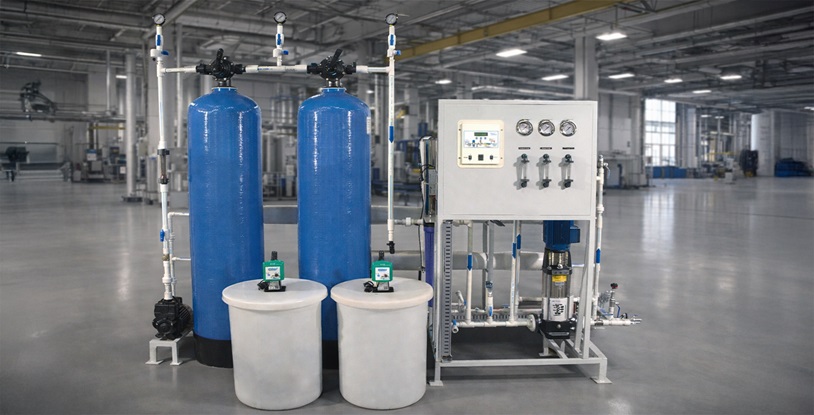
For many businesses, water becomes a problem only when production stops, quality fails, or compliance notices arrive. An RO plant is usually purchased at that stage, often in a hurry and sometimes without clarity. The result is either an oversized system wasting water and power or an undersized one that struggles daily.
If you plan to invest in an RO plant, you should first understand what you are actually buying, how capacity is decided, and where the system will realistically be used. This clarity saves money long after installation.
What an RO Plant Really Does
An RO (Reverse Osmosis) plant is designed to separate usable water from dissolved impurities. These impurities include salts, hardness, heavy metals, silica, and chemical residues commonly found in borewell and tanker water.
Unlike basic filtration, RO does not “improve” water, but it redefines water quality. The output is controlled, measurable, and consistent, which is why RO is preferred in industrial and commercial environments where water quality cannot fluctuate.
Components That Actually Matter (and Why)
Many suppliers list components, but few explain their purpose. Here’s what truly affects performance and lifespan.
1. Pre-Treatment Section
This section decides whether your RO plant lasts two years or ten.
- A sand filter removes physical particles that damage membranes.
- Carbon filter eliminates chlorine and organic matter that chemically attack membranes.
- Softener (where required) prevents scaling caused by calcium and magnesium.
Poor pre-treatment is the number one reason membranes fail early.
2. High-Pressure Pump
This pump pushes water through the membrane. The wrong pump means:
- Unstable flow
- Low recovery
- Higher electricity bills
3. RO Membranes
Membranes define output quality. Selection depends on:
- inlet TDS
- required permeate TDS
- temperature
- recovery rate
There is no “best membrane”, only the right membrane for your water.
4. Structure, Piping, and Valves
Often ignored, but critical. Inferior piping leads to pressure loss, leaks, and frequent downtime. In industrial setups, stainless steel or heavy-grade UPVC piping is not optional.
5. Instrumentation and Controls
Flow meters, pressure gauges, and TDS indicators tell you whether the system is working correctly. Automation reduces dependency on operators and protects the plant during faults.
Understanding RO Plant Capacity
RO plant capacity is not just about litres per hour. It’s about usable water during working hours.
For example:
- A factory needing 20,000 litres over 8 hours does not need a 2,500 LPH plant. It needs a margin for cleaning, losses, and rejects.
- A hospital running 24/7 needs consistency, not peak capacity.
Typical ranges:
- Commercial use: 250-1,000 LPH
- Mid-scale industry: 2,000-10,000 LPH
- Large industry: 20,000 LPH and above
Capacity must factor in:
- Input water quality
- Reject ratio
- Future load increase
- Operating shifts
Buying purely on LPH without context can be a costly mistake.
Where RO Plants Are Actually Used
RO plants are not limited to drinking water.
- Manufacturing: process water, surface treatment, cooling towers
- Pharma & healthcare: formulation water, dialysis, lab usage
- Food & beverage: ingredient water where taste and safety matter
- Hospitality: consistent quality across kitchens and guest use
- Commercial buildings: centralised potable water systems
Each application demands a different design approach.
How Businesses Should Decide What to Buy
A reliable RO plant starts with a water test report, not a quotation. From there, system design should focus on:
- stable output quality
- reasonable water recovery
- service accessibility
- availability of spares
- long-term operating cost, not just capital cost
A cheaper plant that needs frequent repairs is never economical.
If you need a dependable RO water purification plant for commercial use, the Aquaguard 1000 LPH RO Plant is a proven option. It uses a multi-stage RO process to remove dissolved salts, chemicals, and heavy metals, delivering consistent water quality. Designed for continuous operation, it handles high flow rates with ease. The robust build ensures long service life, while low maintenance requirements help reduce downtime and operating costs.
Another reliable option is the Aquaguard RO-500 RO Plant. Designed for large-scale water purification, this 500 LPH system is well-suited for commercial complexes, institutions, and industrial facilities. Its stainless-steel construction ensures durability, while built-in automation supports efficient operation and easy installation.
Conclusion
An RO plant is not a commodity product. It is a process system that supports business continuity. When designed properly, it runs quietly in the background, delivering consistent water day after day. When designed poorly, it becomes a recurring operational headache.
This is why businesses looking for an ‘RO plant near me’ should evaluate not just location, but design capability, service reliability, and post-installation support. Businesses that understand components, capacity, and application don’t just buy an RO plant. They invest in reliability.
Comments are closed.