

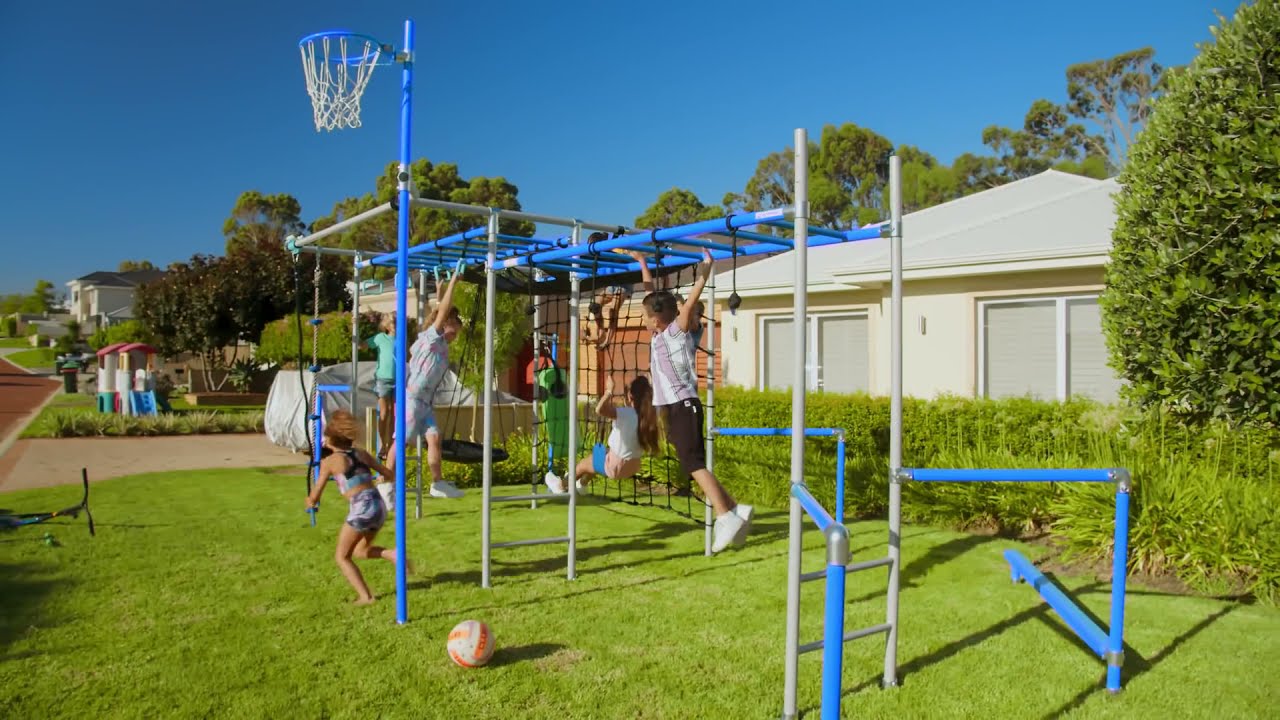
Outdoor play areas are often designed around a child’s current age, but children grow quickly. Equipment that feels exciting today may provide very little interest a few years later.
For families planning a more permanent backyard play area, thinking beyond the next twelve months can make the space more useful and potentially reduce the need for frequent replacements.
A flexible design allows the backyard to change with the family.
Start With Available Space
Before choosing equipment, consider how the backyard is already used.
Families may need room for outdoor dining, pets, gardening, entertaining and general relaxation in addition to children’s activities.
Measuring the available area helps prevent play equipment from overwhelming everything else.
It is also important to think about circulation. People should be able to move between the house, garden and entertainment areas without constantly walking through active play zones.
Think About Different Forms of Movement
Children benefit from having more than one type of physical activity available.
Running is only one form of movement. Outdoor environments can also encourage climbing, swinging, balancing, jumping and coordination.
Instead of selecting several pieces of equipment that provide essentially the same experience, families can create more variety by combining different activities.
Companies operating in this area, including Funky Monkey Bars, illustrate how modern backyard play equipment can incorporate multiple types of activity rather than relying on a single traditional playground feature.
For families, the broader principle is useful regardless of which equipment they ultimately choose: variety tends to keep a play area interesting for longer.
Consider How Interests Change
Young children often enjoy imaginative play and relatively simple physical challenges.
As they grow, they may become interested in more difficult climbing activities, sports, fitness or spending time outdoors with friends.
An outdoor area should ideally leave room for these transitions.
A sandpit, for example, might eventually be removed and replaced with a garden bed or seating area. An open lawn can support countless activities without needing significant changes.
Planning for evolution from the beginning makes these transitions easier.
Avoid Filling Every Available Space
More equipment does not automatically create a better play area.
Crowding the backyard can limit running space, make supervision more difficult and reduce the flexibility of the garden.
Open space is one of the most versatile features a family can have.
It can accommodate ball games, temporary obstacle courses, picnics, tents, water play and many other activities that require no permanent installation.
A combination of fixed features and open areas generally offers more possibilities than a backyard filled entirely with equipment.
Consider Maintenance
Outdoor equipment remains exposed to weather throughout the year.
Before adding anything substantial to the backyard, families should understand what maintenance will be required.
Different materials may need cleaning, inspections, tightening, repainting or other forms of upkeep.
Moving parts should be checked periodically, and the surrounding ground should also remain suitable for active use.
Maintenance may not be the most exciting part of designing a play area, but it contributes significantly to how useful the space remains over time.
Create Somewhere to Rest
Not every part of a play area has to involve activity.
Children often move between energetic games and quieter periods. A shaded bench, outdoor cushions or a small table creates somewhere to stop without needing to return indoors.
Seating can also make the area more comfortable for parents supervising younger children.
When adults and children can comfortably occupy the same outdoor space, the backyard often receives more regular use.
Keep Imaginative Play Possible
Highly specialised equipment sometimes tells children exactly how it should be used.
More open-ended environments allow them to decide.
A platform might become a fort, shop, spaceship or stage depending on the day. Ropes, movable objects and simple structures can become part of constantly changing games.
Leaving some ambiguity in a play environment can make it more interesting rather than less complete.
Design for Several Years, Not One Season
It is impossible to predict exactly how a child’s interests will change.
The most practical approach is therefore flexibility.
Choosing adaptable features, retaining open space and avoiding an overly specialised design gives families more options later.
A backyard play area does not need to remain identical throughout childhood. A successful design provides a strong foundation that can change as the children using it change too.
Comments are closed.